
It’s August 1903. The Sabi Game Reserve — which would later become Kruger National Park — is still wild in every sense of the word. There are no rest camps, no tarred roads, no tourist vehicles. There are a handful of rangers on horseback, a vast and untamed bush, and very little standing between a man and whatever the night might bring.
Harry Wolhuter was one of those rangers. And on the evening of 26 August, the bush came for him.
A routine patrol gone wrong:
Wolhuter had been out on patrol near the Olifants River — routine work for a man who had spent his life in the lowveld. He was travelling with a small team: a handful of African game guards, a string of donkeys loaded with camping gear, and a faithful dog named Bull.
When they reached their intended waterhole for the night, they found it dry. It was already late in the afternoon, the shadows stretching long across the mopane. The next water was roughly twelve miles further south. There was nothing for it but to push on.
The team was moving slowly, the donkeys setting the pace. Wolhuter, impatient to reach camp before dark, made the decision that would nearly cost him his life: he rode ahead alone, with only Bull for company.
This is something any guide in the lowveld will tell you. Dusk is not the time to be moving through the bush. The light fades fast here. Predators are active. The world shifts into something older and less forgiving.
Wolhuter knew this. He pushed on anyway.
Two lions in the dark:
Darkness came quickly, as it does in this part of the world. Wolhuter was navigating by starlight, following a rough track south. Bull started to act up — barking at something in the grass alongside the trail. Wolhuter peered into the shadows and made out a dark shape. He assumed reedbuck, common enough in the area, and thought nothing more of it.
Then the shape charged.
It wasn’t a reedbuck. It was a lion. Wolhuter yanked his horse sharply to the left, but the lion was already in the air. It caught the horse’s hindquarters in its claws. The horse bolted in blind panic — and Wolhuter was thrown.
He hit the ground hard.
As he was gathering himself, still dazed from the fall, he looked up to see the first lion had abandoned the horse and was now coming back for him. Before he could do anything, it had him — jaws clamped around his right shoulder, dragging him backwards through the bush.
There was a second lion. It had circled in behind him.
The knife:
What happened next is the part of this story that has been told around campfires for over a hundred years.
Being dragged through the dark by a lion, shoulder in its mouth, a second predator closing in — most men would have had nothing left. Wolhuter somehow had enough. Hanging from the lion’s jaws, he reached down with his free hand and found the sheath knife on his belt.
He stabbed the lion. Twice in the body, then once in the throat — severing the jugular. The lion released him and staggered back. For a breathless moment, the two of them stared at each other. Then the lion collapsed.
Wolhuter, bleeding heavily and barely able to move, dragged himself to a nearby tree and hauled himself up into the branches just as the second lion arrived on the scene.
Bull saved him. The dog had been barking furiously throughout, and now harassed the second lion relentlessly, keeping it distracted long enough for Wolhuter’s men — who had heard the chaos — to arrive with torches and rifles.
They found their ranger in the tree, alive, barely.
Four days to Komatipoort:
Wolhuter spent a day recovering in the bush before he could be moved. His men fashioned a stretcher — a rough litter — and carried him out on foot, a journey that took four days before they reached Komatipoort and any kind of medical attention.
He survived. He recovered. And he went back to work in the bush.
The knife & the lion skin:
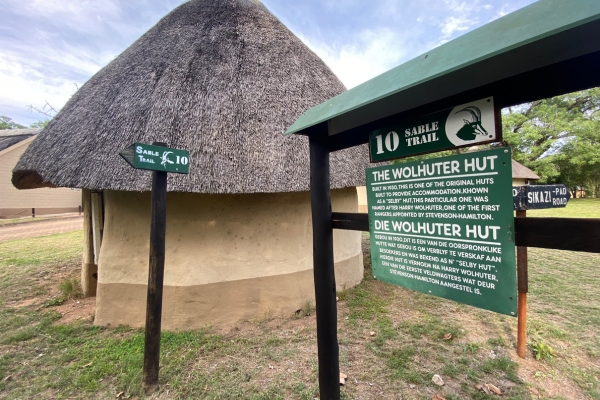
The knife Wolhuter used that night, along with the skin of the lion, are still on display today at the Stevenson-Hamilton Memorial Library at Skukuza Rest Camp. If you find yourself inside Kruger, it’s worth stopping to look at them — a small knife and a faded skin that speak to something extraordinary about the early days of this park and the people who kept it alive.
What this story says about Kruger:
We tell this story not just because it’s gripping — and it is — but because it captures something true about Kruger that gets lost in the tourist brochures.
This park was built by people who lived in the bush, not just visited it. Men like Wolhuter gave their careers, and nearly their lives, to protecting what we now take for granted when we drive through those gates. The lions he encountered that night weren’t villains. They were doing exactly what lions do. And Wolhuter, to his credit, understood that.
He didn’t come back angry. He came back with a deeper respect for the place.
That’s the thing about Kruger. The more time you spend in it, the more it asks of you — in terms of patience, attention, and humility. You are not the most important thing in that landscape. That’s not a threat. It’s the point.
Come and see it for yourself:
We’ve been running day tours and transfers in and around Kruger since 2009. We’re based in Hoedspruit, right at the edge of Greater Kruger, and there isn’t much about this park we haven’t seen.
If you’re planning a visit and you’d like to experience Kruger with someone who knows it properly — not just the roads, but the history, the stories, the rhythms of the bush — we’d love to take you.
Find out more about our Kruger Park Day Tour →


0 Comments