What is the difference between the Greater Kruger Park vs Kruger National Park

What is the difference between the Greater Kruger Park vs Kruger National Park

Most first-time visitors arrive with the same question: should I stay inside Kruger, or book into one of the private reserves? It's a fair question, and the answer depends entirely on what kind of safari experience you're after.

I've been guiding and travelling this landscape since 2009, and I still think it's one of the most underexplained distinctions in South African tourism. So let's clear it up properly.

Kruger National Park: The Heart of It All

Established in 1926, Kruger National Park is one of Africa's great conservation achievements. At roughly 19,500 square kilometres it stretches from the Limpopo River in the north all the way down to Crocodile River in the south — a two-day drive from top to bottom if you pushed it, which nobody should.
It is a public national park, managed by SANParks, and open to everyone. That accessibility is one of its greatest strengths. You can self-drive, follow your own pace, pull over when a herd of elephant crosses the road and sit there for as long as you like. The network of tarred and gravel roads is extensive, rest camps are comfortable and well-run, and the entrance fees are reasonable by international standards.
What Kruger offers that nowhere else can quite match is scale and variety. The northern reaches around Pafuri feel completely different to the open plains of the central Kruger near Satara, which feel different again to the mountainous terrain of the southwest. You could visit a dozen times and still be discovering new corners.
The trade-off is that you share it. Peak season brings other vehicles, gates have operating hours, and off-road driving is not permitted. You stay on the roads, you're back in camp by gate closing time, and night drives are only available on specific guided departures from rest camps.

The Greater Kruger: Where the Fences Come Down

The Greater Kruger isn't a single place — it's a concept. It refers to the broader ecosystem of private game reserves that share unfenced borders with Kruger National Park, allowing wildlife to move freely between public and private land.
On the western boundary alone you have reserves like Sabi Sand, Timbavati, Klaserie, Thornybush, and Balule — each one a privately managed wildlife area with its own lodges, its own character, and its own approach to conservation. Hoedspruit sits right in the heart of this zone, which is one of the reasons it's such a good base.
The private reserve experience is fundamentally different to a self-drive in Kruger. You're in an open Land Rover with a trained guide and a tracker, going off-road when the animals lead you there, out before dawn and back out again at sunset. Night drives are standard. Walking safaris are on the table. Sightings of leopard — notoriously elusive in Kruger — are almost routine in places like Sabi Sand, simply because the guides and trackers know every individual animal by name.
The lodges range from comfortable bush camps to some of the most celebrated luxury properties in Africa. You're paying for exclusivity, expertise, and an immersive experience rather than the freedom to explore independently.

So Which One is Right for You?

Both, ideally — and that's not a cop-out answer.
A day trip into Kruger from Hoedspruit gives you that raw, self-directed encounter with the bush that no guided experience quite replicates. There's something deeply satisfying about spotting a pride of lions yourself, with no guide pointing the way.
But if you want to go deeper — if you want to understand what you're looking at, track an animal on foot, or watch a leopard feed in the last light of the evening — then a night or two in one of the private reserves around Hoedspruit will change how you see the whole landscape.
We work with guests across both worlds at Buya Buya, and we're happy to help you figure out the combination that suits your time, your budget, and what you're actually hoping to feel when you're out there.

Rich history of the Kruger Park : A journey through time

Rich history of the Kruger Park : A journey through time

A Journey through time - Kruger Park

Kruger National Park stands as a testament to the preservation of South Africa's diverse wildlife and natural heritage. In this blog post, we invite you on a captivating journey through time, exploring the intriguing history that has shaped this iconic national park into what it is today.

ORIGINS & EARLY DAYS

Kruger National Park traces its roots back to 1898 when the South African government established the Sabie Game Reserve, the precursor to the present-day park. The primary objective was to protect the region's dwindling wildlife populations, particularly the iconic African elephants and rhinos.

The Influence of Paul Kruger:
The park owes its name to Paul Kruger, the former President of the South African Republic (Transvaal). Kruger played a pivotal role in promoting wildlife conservation, leading to the expansion of the reserve's boundaries. His vision and passion for nature preservation continue to inspire the park's ethos.

Development and Expansion:
Over the years, the park underwent significant expansion, with the merging of various adjacent reserves and the inclusion of additional land. This expansion allowed for the protection of a more extensive range of wildlife and the establishment of diverse ecosystems within the park's boundaries.

The Transfrontier Park Initiative:
In 2002, a groundbreaking conservation effort led to the establishment of the Great Limpopo Transfrontier Park. This initiative aimed to create a vast transboundary conservation area, linking Kruger National Park with Mozambique's Limpopo National Park and Zimbabwe's Gonarezhou National Park. It facilitates wildlife migration, promotes regional cooperation, and contributes to biodiversity conservation on a larger scale.

Conservation Success and Challenges:
Kruger National Park has been a pioneering force in wildlife conservation, achieving remarkable successes in the preservation of endangered species such as the black and white rhinos. However, the park also faces ongoing challenges, including poaching, habitat loss, and human-wildlife conflict. Conservation efforts and community involvement play crucial roles in addressing these challenges.

Tourism and Sustainable Practices:
Tourism has become an integral part of Kruger National Park's identity, attracting visitors from around the globe. To ensure the long-term sustainability of the park, initiatives promoting responsible tourism, environmental education, and community empowerment have been implemented, fostering a harmonious relationship between conservation and tourism.

Conclusion:
As we reflect on the rich history of Kruger National Park, we gain a deeper appreciation for its significance as a haven for wildlife and a symbol of conservation triumphs. From its humble beginnings to its present-day prominence, the park continues to inspire and awe visitors with its natural beauty and the tireless dedication of those committed to its preservation. Join us on a journey through time as we celebrate the history that has shaped Kruger National Park into an enduring sanctuary for future generations to cherish.


Moholoholo – The great battle

Moholoholo – The great battle

THE BATTLE OF MOHOLOHOLO

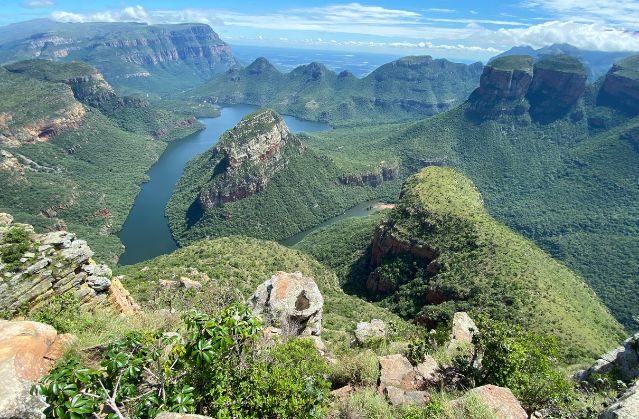
The Blyde Canyon stands as a captivating natural wonder, renowned for being the largest verdant canyon globally and hosting a captivating variety of wildlife.

Presently, this region has become a favored spot among international travelers who have embarked on a long journey to our shores. It serves as a popular stopover for those en route to the Kruger Park.
However, well before this area gained recognition, an epic clash unfolded between two formidable adversaries: Chief Maripe Mashile, leading the Mapulana tribe, and King Mswati II, commanding the Swazi soldiers.

HOW IT HAPPENDED

During a tumultuous period known as the "Mfecane," which translates to "crushing or scattering," the Mapulana people had established their settlement in the vicinity of the Blyde Canyon. This era was marked by conflicts among the indigenous tribal groups of Southern Africa, leading to the displacement of numerous communities in the region.

In 1845, King Mswati II ascended to the throne, succeeding his father, and commenced a series of raids that instilled fear in the hearts of people both nearby and afar.

In 1864, a band of Swazi raiders launched an assault on the Mapulana residing beside the Blyde River. Forced to retreat, the Mapulana sought refuge atop a nearby mountain and began gathering substantial rocks at its summit, preparing for the impending attack.

Recognizing the peril of assaulting the mountain without cover, the Swazi raiders withdrew to a close vicinity, patiently awaiting the mist to shroud the peak. They intended to employ the mist as a shield while launching a surprise attack on the unsuspecting Mapulanas positioned on the summit.

Their wait didn't last long. One fateful night, a layer of mist engulfed the mountain, prompting the Swazi soldiers to ascend from the southern side. However, the Mapulana were well-prepared and vigilant. As soon as the first Swazi soldier was spotted, they unleashed the amassed collection of boulders, sending them hurtling down the path. The unsuspecting Swazi soldiers suffered significant casualties as a consequence.

Legend has it that the remains of those fallen Swazi soldiers can still be glimpsed within the inaccessible rock crevices of the mountain.

AFTERMATH

The mountain where the epic battle unfolded was named Mariepskop, in honor of Chief Maripe Mashile, the skilled leader who guided his Mapulana people to victory that day.

The site where the Swazi party camped while awaiting their attack was situated alongside the Blyde River, adjacent to a prominent buttress. Over time, this location came to be known as Swatini, meaning 'place of the Swazis'. Today, a holiday resort occupies this spot, albeit mistakenly called Swadini.

The river where the Swazis suffered their defeat was originally named 'Motlasedi', signifying 'where the battle occurred'. However, it is now commonly referred to as Klaserie, a distorted version of the word Motlasedi in Afrikaans.

The battle acquired the name Moholoholo, denoting 'the great battle'.

The surviving Swazi warriors harbored apprehension about returning to their king, fearing retribution for their failed mission. Instead, they opted to settle in other parts of the region, where their descendants can still be found today.

Around the same period, small groups of Voortrekkers were traversing the area, seeking a passage down the formidable escarpment to reach the port of Laurenco Marques, known as Mozambique today. This eventually led to the establishment of the towns of Ohrigstad and Lydenberg in close proximity.

Pilgrims Rest – A History

Pilgrims Rest – A History

pilgrims rest
a Short History

YEARS 1845 - 1877

Journey back in time to the thrilling gold rush era of the 1870s in what was then the Transvaal province. At a location 5 km away from the future town, a remarkable discovery of payable gold sparked the birth of Pilgrim's Rest. One man, Alec 'wheelbarrow' Patterson, sought his fortune beyond the crowded diggings. With his trusty wheelbarrow, he ventured into the surrounding hills, ultimately striking it rich in a small stream now known as Pilgrims Creek. Keeping his find a secret, Patterson toiled away until William Trafford stumbled upon gold nearby, forever altering the course of history. News of the golden treasure spread far and wide, drawing people from across the globe to the burgeoning site.

In 1873, the site was officially designated a gold field, and approximately 1,500 diggers were busy working 4,000 claims in and around the creek. As the population swelled, more permanent structures were erected, heralding the official opening of the town for business.

Pilgrim's Rest boasted the discovery of notable large nuggets, including the renowned Breda nugget, weighing an impressive 6 kg. However, by 1880, the alluvial gold deposits began to dwindle, prompting most diggers to seek new sites in the region. This paved the way for mining companies that employed machinery to explore deeper in their pursuit of gold. Recognizing the need for electricity to handle the growing workload of crushing the increasingly abundant gold ore, plans were set in motion to construct a hydro plant in the breathtaking Blyde River Canyon. In 1911, Pilgrim's Rest became the second town in South Africa to enjoy the marvel of electric power.

Over time, as gold deposits gradually diminished, mining companies started to withdraw, and Pilgrim's Rest faced the prospect of becoming a ghost town. The land was deemed no longer of value to the mining industry, prompting its sale to the local government. Eventually, in 1986, Pilgrim's Rest was rightfully declared a national monument.

Today, the town remains a remarkable reflection of its early days. The enduring charm of the past is embodied in the preserved old buildings, while the renowned Royal Hotel continues to extend a warm welcome to visitors from around the world. The historic Church Pub still serves exquisite South African beer, allowing visitors to savor the flavors of the bygone era. Although the dusty roads and horse-drawn highwaymen have faded into history, the legendary allure and old-world charm of Pilgrim's Rest continue to captivate all who visit.